
Events
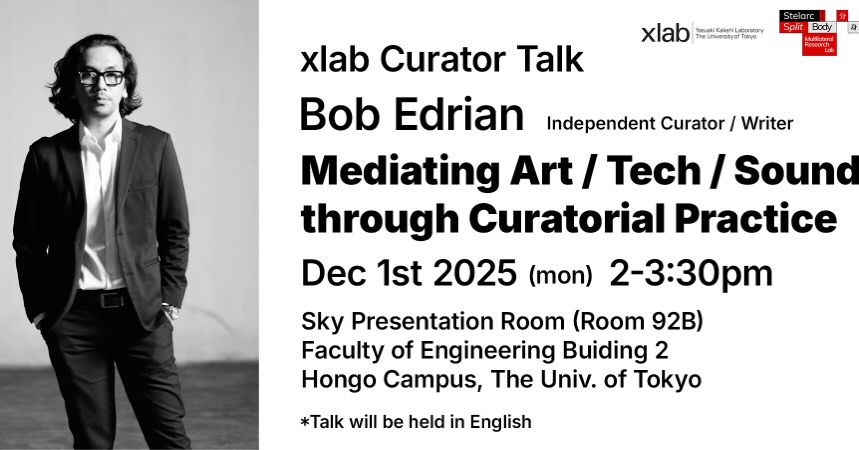
📍12/1 14:00-15:30 Yasuaki Kakehi Lab. / xlab UTokyo @xlab_utokyo
We’ll welcome Bob Edrian @bobedrian Indonesian intermedia art curator to give a talk and exchange ideas with xlab at Tokyo University!
Please register and join! Free Entrance✨
Registration :
https://xlab-guesttalk002.peatix.com/view
[On-site Talk Session]
Oct 13th (Mon)18:00-20:30JST @Tokyo University of the Arts
Participants: Stelarc, Oron Catts, Hideo Iwasaki, Shiho Fukuhara, Tomoko Shimizu
Info: https://ga.geidai.ac.jp/2025/10/02/art-and-technology/
Reservation:https://forms.gle/eTP9rohPRSxCUQi8A
“Where Does the Body Begin? — Ethical Horizons in Art and Technology”
Proposed Summary: Where does the body begin, and where does the “self” end? The conceptual frameworks underpinning the modern notions of “individual” and “subject” are now being profoundly challenged. Whose body is it, after all?
This talk event welcomes internationally renowned artist Stelarc, bioart pioneer Oron Catts, Hideo Iwasaki who develops new artistic practices exploring life sciences and expression, and Shiho Fukuhara who re-examines ethics at the boundaries of technology and the body. Together, they will delve into fundamental questions concerning the body, ethics, and technology. This dialogue will multifacetedly examine issues surrounding biotechnology, cyborgization, bioethics, and the relationship between humans and the environment. From the intersection of art and technology, we will envision future conceptions of the body and ethical shifts. We warmly invite you to participate.
Stelarc (Australia)

Stelarc
Stelarc is an Australian performance artist, who has lived in Japan for 19 years. His projects and performances explore alternate anatomical architectures, interrogating issues of embodiment, agency, identity and the post-human. Stelarc’s works incorporate Prosthetics, Robotics, Medical Imaging and Biotechnology.
Between 1973-1975 he made 3 films of the inside of his body. Between 1976-1988 he completed 27 body suspensions with insertions into his skin. He has performed with a Third Hand, a Stomach Sculpture and Exoskeleton, a 6-legged walking robot. Fractal Flesh, Ping Body and Parasite are internet performances that explore remote and involuntary choreography via a muscle stimulation system. He is surgically constructing and stem-cell growing an ear on his arm that will be electronically augmented and internet enabled. For the 2020 Adelaide Biennial of Australian Art he exhibited and performed with a 9m long 4m high Reclining StickMan robot with online interactivity. His recent projects and performances in 2022 include Anthropomorphic Machine, Melbourne, Human / Code Ensemble, Yokohama and StickMan / miniStickMan, Melbourne. In 2023, Corporeal Counterpoint at Keio Media Design, Yokohama, Sculpting Sound, Krakow, and in 2024, “KYOSHIN” Sonic Resonance at CCBT, Shibuya, Tokyo, followed by the UNESCO Creative Cities of Media Art Global Forum “공진”,G.MAP, Gwangju, South Korea.
1996 Honorary Professor of Art and Robotics at Carnegie Mellon University, Pittsburgh, USA.
2002 Honorary Doctor of Laws by Monash University, Melbourne, Australia.
2010 Golden Nika, Ars Electronica Hybrid Arts Prize, Linz, Austria.
2015 Australia Council Emerging and Experimental Arts Award, Sydney, Australia.
2016 Honorary Doctorate from the Ionian University, Corfu.
2013-2018, Stelarc was a Distinguished Research Fellow, Curtin University, Perth, Australia.
Oron Catts (Australia)

Artist / Researcher / Curator: Oron Catts ( Institute of Advanced Studies, University of Western Australia)
https://research-repository.uwa.edu.au/en/persons/oron-catts
He is the Director of The University of Western Australia’s Institute of Advanced Studies. He Co-founded and directed SymbioticA, a biological art research center at UWA (2000-2024), now an independent lab. In 1996 he launched the Tissue Culture and Art Project which is considered a leading biological art project.He is a Visiting Professor in the Visual Identities in Art and Design Research Centre, University of Johannesburg. Catts was a Research Fellow in Harvard Medical School, a visiting Scholar at the Department of Art and Art History Stanford University, a Professor at Large in Contestable Design at the Royal College of Arts, London. Catts curated more than a dozen exhibitions, developed numerous artistic projects and performances. His work was exhibited and collected by museums such as Pompidou Centre, MoMA NY, Mori Art Museum, Ars Electronica, National Art Museum of China and more. His research was covered by The NY Times, Washington Post, Wired, Time, Newsweek, Nature, Science, and other TV, radio, print and online media.
Hideo Iwasaki (Japan)

Researcher: Hideo Iwassaki (Waseda University)
Director of metaPhorest (bioaesthetics platform), Professor, Waseda University
metaPhorest: https://metaphorest.org/en/about/
Biologist and artist. Director of metaPhorest (bioaesthetics platform), Professor, Waseda University. He is interested in the complicated relationship among scientific, philosophical, cultural, historical and aesthetic views of life. In 2007 he founded metaPhorest, an interdisciplinary art/science platform, where both artists and biologists share space for science and art simultaneously. He has also studied molecular microbiology and chronobiology, and is a co-founder of the Japanese synthetic biology society (Japanese Society for Cell Synthesis Research). He has received the Excellent Award of the Japan Media Art Festival, Research Awards from Japanese Chronobiology Society and Japanese Society for Microbial Genomics, etc.
Shiho Fukuhara (Japan)

An artist/designer who explores the ethics of life and technology.
She founded Biopresence Ltd. in the UK in 2004 and received the NESTA Pioneer Award and Prix Ars Electronica Honorary Mention. She is active in the artistic research field of “bcl” and Human Awesome Error (HAE), which aims to rediscover “ethics” and “error” in creativity.
At Google, she led research into connecting the body and technology through fashion materials, which contributed to the Cannes Lions Product Design Grand Prix. While developing materials for the Hardware Design category, she also works at Poiesis Labs in Kyoto, where she explores the intersection of material boundaries and ethical concepts.
[On-site Lab Tour, Talk&Workshop]
Oct 8th(Wed) 16:30-17:30JST Cybernetic being Lab Tour
18:00-20:30JST Jill Orr Talk & Stelarc Workshop
Venue: Cybernetic Being Lab – Tokyo Port City Takeshiba Office Tower 8F, CiP/ Keio Media Design
https://www.embodiedmedia.org/about
https://cybernetic-being.org/about/
Reservation: https://kmd-stelarclab.peatix.com
16:30-17:30JST Cybernetic being Lab Tour
We will hold a special open lab tour by the Embodied Media Project at the Keio University Graduate School of Media Design (KMD) showcasing and demonstrating the prototypes under research development. Participants will have the opportunity to explore the activities of each project through demonstrations of prototypes currently under development.
Keio University Graduate School of Media Design (KMD): https://www.kmd.keio.ac.jp/ja/
Embodied Media project (EM): https://www.embodiedmedia.org/about
Project Cybernetic being: https://cybernetic-being.org/activities/202203_cybernetic-being-exhibition/


18:00-20:30JST Jill Orr Talk & Stelarc Workshop
We will hold a special artist talk by Jill Orr and an on-site workshop by Stelarc at the KMD Lab space in Takeshiba, Tokyo!
It will be a great opportunity to learn from the representative performance artists from Australia bringing perspectives on performance and physical embodiment of artistic visions.
Participants:
- Jill Orr(Online) , Stelarc(On-site)
- Artist Talk & Workshop: 18:00-20:30
[Artist Talk(Online) : 18:00-19:00]
Stelarc Australia)
Stelarc
Stelarc is an Australian performance artist, who has lived in Japan for 19 years. His projects and performances explore alternate anatomical architectures, interrogating issues of embodiment, agency, identity and the post-human. Stelarc’s works incorporate Prosthetics, Robotics, Medical Imaging and Biotechnology.
Between 1973-1975 he made 3 films of the inside of his body. Between 1976-1988 he completed 27 body suspensions with insertions into his skin. He has performed with a Third Hand, a Stomach Sculpture and Exoskeleton, a 6-legged walking robot. Fractal Flesh, Ping Body and Parasite are internet performances that explore remote and involuntary choreography via a muscle stimulation system. He is surgically constructing and stem-cell growing an ear on his arm that will be electronically augmented and internet enabled. For the 2020 Adelaide Biennial of Australian Art he exhibited and performed with a 9m long 4m high Reclining StickMan robot with online interactivity. His recent projects and performances in 2022 include Anthropomorphic Machine, Melbourne, Human / Code Ensemble, Yokohama and StickMan / miniStickMan, Melbourne. In 2023, Corporeal Counterpoint at Keio Media Design, Yokohama, Sculpting Sound, Krakow, and in 2024, “KYOSHIN” Sonic Resonance at CCBT, Shibuya, Tokyo, followed by the UNESCO Creative Cities of Media Art Global Forum “공진”,G.MAP, Gwangju, South Korea.
1996 Honorary Professor of Art and Robotics at Carnegie Mellon University, Pittsburgh, USA.
2002 Honorary Doctor of Laws by Monash University, Melbourne, Australia.
2010 Golden Nika, Ars Electronica Hybrid Arts Prize, Linz, Austria.
2015 Australia Council Emerging and Experimental Arts Award, Sydney, Australia.
2016 Honorary Doctorate from the Ionian University, Corfu.
2013-2018, Stelarc was a Distinguished Research Fellow, Curtin University, Perth, Australia.
Jill Orr (Australia)

Jill Orr ジル・オー
Jill Orr’s work centres on the psycho- social and environmental where she draws on land and identities as they are shaped in, on and with the environment be it country or urban locales. Orr grapples with the balance and discord that exists at the heart of relations between the human spirit, art and nature. Orr is a performance artist crossing between performances for live audiences and performances for the camera. She has produced iconic images reflecting an Australian perspective.
Jill has presented works in Australia and internationally since the late 1970’s and is regularly invited to exhibit in national and international curated exhibitions and events. She was represented in the inaugural Venice International Performance Art Week in 2012. She was awarded an Australia Council Fellowship to produce Antipodean Epic from 2015-7. Recent works include Detritus Springs, Listen, Laundry and Dark Night that have each been commissioned for 2018 and 2019 exhibitions. In 2020-2021, Jill was represented in Australia: Antipodean Stories at PAC Padiglione d’Art Contemporanea, Milan, curated by Eugenio Viola. Orr is currently showing Same Place, Different Time at This Is No Fantasy, Gallery, Melbourne.

[On-site Session + Live Streaming]
Oct 7th(Tue) 17:00-22:00JST Multilateral Lab Meetup , Talk Session & Performance
Participants: Stelarc, Kouta Minamizawa, Tomoko Shimizu, Hideo Iwasaki,Leonhard Bartolomeus, Anna Daivis, Pat Pataranutaporn, Kawita Vatanajyankur, Abigail Bernal, Agung Hujatnika, Irene Agrivina, Jeffi Manzani
Performance: Shin Hanagata, Goki Muramoto
Venue: Shibuya QWS Scramble Hall : https://shibuya-qws.com/rental-scramblehall
Reservation:https://stelarc-cyberneticbeing.peatix.com
Main Events

Cybernetic being Meetup vol.9
STELARC/BUNSHIN: Split Body Multilateral Research Lab
Art & Science International Meetup in Tokyo 2025
– Does SPLIT BODY mean Bunshin ? –
[ On-site session + Live Streaming ]
Oct 7th(Tue) 17:00-21:00JST Multilateral Lab Meetup , Talk Session & Performance
Venue: Shibuya Scramble Square 15F Shibuya QWS Scramble Hall :https://shibuya-qws.com/about/outline
Organizer(Venue Support):SHIBUYA QWS Innovation Council
Co-organizer:Keio University Graduate School of Media Design(KMD), Project Cybernetic being (JST Moonshot R&D Program Goal 1: “Cybernetic Avatar Technology and Social System Design for Harmonious Co-experience and Collective Ability”), STELARC / BUNSHIN: Split Body Multilateral Research Lab, Living Together Co.
Initiator:Living Together Co.
Grant by:Pola Art Foundation, Toshiaki Ogasawara Memorial Foundation, Australia-Japan Foundation
Graphic Design : Nana Biakova(Living Together Co.)
<< Special Contributor >>
Event Operation & Management:Kazuya Ohara, Riou Sakurai, Satomi Tanabe (Keio University Graduate School of Media Design), Akane Kanagawa, Cai Xun (Living Together Co.)
Multilingual Archive:Kentaro Taki, Goki Muramoto,Takayoshi Koyama, Satoshi Ikeda
Translation Support:Madoka Minamisawa, David d’Heilly
Event Documentation & Technical Support:Taki lab. Department of Arts, Tokai University, VIDEOART CENTER Tokyo, Masato Takemura
Website & Digital Promotion Support:JJ Adibrata, Olia Fedorova (Living Together Co.)
<< Special Thanks >>
Kouta Minamizawa (Professor at Keio University Graduate School of Media Design)
Kai Kunze (Professor at Keio University Graduate School of Media Design)
Event Panels
Stelarc (Australia)
Stelarc is an Australian performance artist, who has lived in Japan for 19 years. His projects and performances explore alternate anatomical architectures, interrogating issues of embodiment, agency, identity and the post-human. Stelarc’s works incorporate Prosthetics, Robotics, Medical Imaging and Biotechnology.
Between 1973-1975 he made 3 films of the inside of his body. Between 1976-1988 he completed 27 body suspensions with insertions into his skin. He has performed with a Third Hand, a Stomach Sculpture and Exoskeleton, a 6-legged walking robot. Fractal Flesh, Ping Body and Parasite are internet performances that explore remote and involuntary choreography via a muscle stimulation system. He is surgically constructing and stem-cell growing an ear on his arm that will be electronically augmented and internet enabled. For the 2020 Adelaide Biennial of Australian Art he exhibited and performed with a 9m long 4m high Reclining StickMan robot with online interactivity. His recent projects and performances in 2022 include Anthropomorphic Machine, Melbourne, Human / Code Ensemble, Yokohama and StickMan / miniStickMan, Melbourne. In 2023, Corporeal Counterpoint at Keio Media Design, Yokohama, Sculpting Sound, Krakow, and in 2024, “KYOSHIN” Sonic Resonance at CCBT, Shibuya, Tokyo, followed by the UNESCO Creative Cities of Media Art Global Forum “공진”,G.MAP, Gwangju, South Korea.
Kouta Minamizawa (Japan)

Researcher: Kouta Minamizawa (Keio University)
Professor, Keio University Graduate School of Media Design (KMD)
Project Manager, Project Cybernetic being, JST Moonshot R&D Program
KMD Embodied Media Project https://www.embodiedmedia.org
JST Moonshot | Project Cybernetic being https://cybernetic-being.org
Haptic Design Project http://hapticdesign.org
After receiving his PhD. in Information Science and Technology from the University of Tokyo in 2010, he joined KMD and directs KMD Embodied Media Project, where conducts research and social deployment of embodied media that transfer, enhance, and create human experiences with digital technologies. His research expertise includes Haptics, Embodied Interaction, Virtual Reality, and Telexistence. He also promotes activities on Haptic design as well as serves as a project manager of the Cybernetic being project under the Japan government’s Moonshot R&D program.
Tomoko Shimizu (Japan)

Researcher : Tomoko Shimizu ( Tokyo University of the Arts )
Professor at the Graduate School of Global Arts, Tokyo University of the Arts
https://www.shimizu.geidai.ac.jp/about
Professor at the Graduate School of Global Arts, Tokyo University of the Arts. Her areas of specialization include cultural theory and media studies. Focusing on the intersections of art and technology, her research engages with themes such as animal, gender, the body, and posthumanism. She holds a Ph.D. in Literature from the Doctoral Program in Literature and Linguistics at the University of Tsukuba. She previously held teaching and research positions at Yamanashi University and the University of Tsukuba, and served as a visiting scholar at the Reischauer Institute of Japanese Studies, Harvard University (Fulbright Fellow), and at Freie Universität Berlin. She is the author of Bunka to Bouryoku (Culture and Violence: The Unravelling Union Jack) Getsuyosha 2013, and Dizuni to Doubutsu (Disney and Animals: Breaking the Spell of Magic Kingdom) Chikuma Shobo 2021. Her co-translation works include: Notes Toward a Performative Theory of Assembly by Judith Butler, Declaration by Antonio Negri and Michael Hart, and Surveillance after September 11 by David Lyon.
Hideo Iwassaki (Japan)
Researcher: Hideo Iwassaki (Waseda University)
Director of metaPhorest (bioaesthetics platform), Professor, Waseda University
metaPhorest: https://metaphorest.org/en/about/
Biologist and artist. Director of metaPhorest (bioaesthetics platform), Professor, Waseda University. He is interested in the complicated relationship among scientific, philosophical, cultural, historical and aesthetic views of life. In 2007 he founded metaPhorest, an interdisciplinary art/science platform, where both artists and biologists share space for science and art simultaneously. He has also studied molecular microbiology and chronobiology, and is a co-founder of the Japanese synthetic biology society (Japanese Society for Cell Synthesis Research). He has received the Excellent Award of the Japan Media Art Festival, Research Awards from Japanese Chronobiology Society and Japanese Society for Microbial Genomics, etc.
Leonhard Bartolomeus (Indonesia)

Curator: Leonhard Bartolomeus ( YCAM Curator , Ruangrupa Curator)
https://performingarts.jpf.go.jp/en/article/6821/
Curator of Yamaguchi Center for Arts and Media (YCAM)
Based in Indonesia’s capital of Jakarta is the artistic collective “ruangrupa” that engages in a wide range of community-centric activities, from organizing exhibitions and festivals, producing radio broadcasts and engaging in online publishing, surveys, research and more (including serving as artistic directors for documenta 15 in 2022). As of 2019, a member of the collective, Leonhard Bartolomeus, has joined the curator team of the Yamaguchi Center for Arts and Media (YCAM), an organization known for its progressive explorations of forms of expression utilizing media technology.
Anna Davis (Australia)

Curator: Anna Davis (Curator, Museum of Contemporary Art Australia)
https://www.mca.com.au/about-us/who-we-are/curators/
Anna Davis is a curator and researcher of contemporary art with over 20 years’ experience. As Curator at the Museum of Contemporary Art Australia, she is a leading advocate for the arts, shaping and presenting the museum’s artistic program, developing exhibitions and commissions, and contributing to the growth and display of its permanent collection. Anna has led major exhibition projects and commissions with artists including Tarek Atoui, Zheng Bo, Daniel Boyd, Yuko Mohri, Marguerite Humeau, Moon Kyungwon & Joonho Jeon, Patricia Piccinini, Stelarc and Lu Yang. Her exhibitions have been presented at institutions such as the Museum of Modern and Contemporary Art (MMCA) Korea, Christchurch Art Gallery Te Puna o Waiwhetū, Aotearoa New Zealand, The Art Gallery of New South Wales, Perth Institute of Contemporary Arts (PICA), and TarraWarra Museum of Art, Victoria.
Anna’s research focuses on the intersections of art, technology, and future ecologies, encouraging critical thinking around these connections. Her curatorial practice emphasises creating new platforms for artists to present experimental work and fostering interdisciplinary dialogue with diverse audiences. In 2022, she was one of five co-curators of rīvus: the 23rd Biennale of Sydney, which highlighted non-human perspectives through a series of conceptual wetlands across the city. In 2015/16, she co-curated New Romance: Art and the Posthuman and was co-director of Energies in the Arts, a multidisciplinary research project presented in conjunction with her award-winning exhibition, Energies: Haines & Hinterding.
Anna holds a PhD in Media Arts from the University of New South Wales and is a frequent presenter on contemporary art. Her writing contributes significantly to the field, and she has edited and authored numerous exhibition catalogues and artist monographs, including Jenny Watson: The Fabric of Fantasy (2017), Claire Healy & Sean Cordeiro (2012), Sun Xun (2018), and most recently, Nicholas Mangan: A World Undone (2024), co-edited with Anneke Jaspers and published by MCA Australia and Lenz Press, Milan.
Pat Pataranutaporn (Thailand)

Pat Pataranutaporn
Pat Pataranutaporn, Ph.D. is an assistant professor and a researcher at the Massachusetts Institute of Technology (MIT). He serves as a co-director of the Cyborg Psychology research group at the MIT Media Lab and also the Advancing Humans with AI (AHA) research program Research Program. His research lies at the intersection of AI and human-computer interaction, where he develops and studies AI systems that support human flourishing.
Pataranutaporn’s research contributions have been published in numerous peer-reviewed journals and conferences, such as Nature Machine Intelligence, The New England Journal of Medicine AI, ACM SIGCHI, ACM IUI, ACM SIGGRAPH, IEEE, and NeurIPS. His work has been highlighted by the United Nations AI for Good forum, and has been featured in MIT Tech Review, the Guardian, New York Times, Washington Post, Forbes, the Atlantic, Scientific American, Wall Street Journal, National Geographic, and more. Pataranutaporn’s work has also been honored as one of TIME’s “Best Inventions of 2023” and was included in Fast Company’s “World Changing Ideas” in 2023 and 2025.
Pataranutaporn has been awarded fellowships and grants by multiple research agencies and corporations, including NASA, OpenAI, MIT J-WEL, KBTG, Bose, MQDC, and NTT Data. He has also collaborated with researchers from both academia and industry, including researchers from Stanford Medicine, Harvard, Mass General Brigham, UCSB, UCLA, UC Irvine, Microsoft Research, OpenAI, NTT Data, and more.
Pat’s projects have been exhibited at the MIT Museum (Massachusetts), Asia Pacific Triennial (Queensland Art Gallery, Australia), The Art Gallery of Western Australia (Australia) MAXXI – National Museum of 21st Century Art (Italy), Bangkok Art Biennale (Thailand), Bangkok City Gallery (Thailand), National Museum of Singapore (Singapore), Essex Peabody Museum (USA), London Design Festival (UK), Transmediale Festival (Germany), National Taiwan Science Education Center (Taiwan), IDEA Museum (Arizona), Mesa Arts Center (Arizona), Autodesk Gallery (California), SIGGRAPH Asia (Tokyo), Ars Electronica (Virtual) and more. Pat also serves as the co-creator and writer for the Netflix sci-fi anthology series “Tomorrow and i” premiered in 2024.
Kawita Vatanajyankur (Thailand)

Kawita Vatanajyankur
Kawita Vatanajyankur has gained international recognition since graduating with a BA in Fine Art from RMIT University in 2011. In 2015, she was a Finalist in the Jaguar Asia Pacific Tech Art Prize. Two years later, her work was included in Islands in the Stream in Venice, held alongside the 57th Venice Biennale, and she was selected to present at both the Asia Triennale of Performing Arts at Melbourne Arts Centre and the Asian Art Biennial in Taiwan.
In 2018, Vatanajyankur participated in the inaugural Bangkok Art Biennale, followed by her inclusion in Absurdity in Paradise at the Fridericianum Museum, Kassel. The following year, she presented her largest museum exhibition to date, Foul Play, at the Albright-Knox Art Gallery in New York.
In 2021, her works featured in Collecting Entanglements and Embodied Histories at Maiiam Contemporary Art Museum (Chiang Mai) and Hamburger Bahnhof (Berlin), as well as in Balance at Hamburger Bahnhof. That year, she also joined the third Bangkok Art Biennale (Chaos and Calm) and exhibited in Fun Feminism at Kunstmuseum Basel (Switzerland) and The Uncanny World at the Museum of Contemporary Art Busan (Korea).
In 2023, Vatanajyankur presented a solo booth with Nova Contemporary in the Discovery section of Art Basel Hong Kong. In 2024, she exhibited in The Spirits of Maritime Crossing, an official collateral exhibition of the Venice Biennale, and was among the selected artists for the 11th Asia Pacific Triennale (APT11) in Brisbane, Australia.
Vatanajyankur has exhibited extensively across Australia, Asia, Europe, and the United States. Her works are represented in major public collections, including the National Collection of Thailand, Queensland Gallery of Modern Art (QAGOMA), Singapore Art Museum, JUT Art Museum (Taiwan), M Woods Museum (China), Dunedin Public Art Gallery (New Zealand), Maiiam Contemporary Art Museum (Thailand), DIB Contemporary Art Museum (Thailand), and the Museum of Contemporary Art (MOCA, Thailand), as well as numerous university and private collections worldwide. She is represented by Nova Contemporary, Bangkok.
Abigail Bernal (Australia)

Abigail Bernal is Associate Curator, Asian Art at the Queensland Art Gallery | Gallery of Modern Art (QAGOMA). As part of the lead curatorial team for QAGOMA’s flagship exhibition, the Asia Pacific Triennial of Contemporary Art, she has contributed to seven editions, developing major commissions and partnerships with artists and communities across Southeast, Central, and West Asia. Her practice explores the intersections of contemporary, customary, and vernacular art, with a focus on global Indigenous perspectives. Selected exhibitions include Mindanao and the Sulu Archipelago: Roots and Currents (2024-25), I Can Spin Skies (2024), Unfinished Business: The Art of Gordon Bennett (2020), and Kalpa Vriksha: Indigenous and Contemporary Art of India (2015). She publishes across catalogues, journals, and online platforms, with recent texts in the Asia Pacific Art Papers, Art Republik Vietnam, and The Asian Arts Society of Australia (TAASA) Review. Upcoming exhibitions include APT12 and The God of Small Things: Faith and Popular Culture.
Agung Hujatnika (Indonesia)

Dr. Agung Hujatnika, a.k.a Agung Hujatnikajennong, is a freelance curator and lecturer at the Faculty of Art and Design, Bandung Institute of Technology, Bandung, Indonesia. His research interest spans around curatorial practice, new media and Indonesian contemporary art. Amongst other exhibitions he has curated are ‘Fluid Zones’, Jakarta Biennale ARENA (2009); ‘Exquisite Corpse’, Bandung Pavilion for Shanghai Biennale (2012); ‘Not a Dead End’, Jogja Biennale – Equator #2 (2013); ‘1001 Martian Homes’ for Indonesian Pavilion at Venice Biennale (2017), and; ‘Art Turns. World Turns’, at Museum MACAN, Jakarta (2017). He was the initiator and artistic director of INSTRUMENTA International Media Art Festival in Jakarta (2018-1019). His latest curatorial projects include a triplet editions for ‘ARTJOG | arts-in-common’, a series of thematic exhibitions focusing on the ideas of space, time and consciousness (2019-2022). Since 2022, Agung has convened and run Open Arms, a series of activities dedicated to strengthening disability inclusion in Indonesian art. His book, ‘Kurasi dan Kuasa’, on curatorial practice and power relations in the Indonesian art world was published by the Jakarta Art Council (2015).
Irene Agrivina (Indonesia)

Full name : Irene Agrivina Widyaningrum [1976]
URL : http://honf.org
Resume/CV : http://bit.ly/IRENEAGRIVINARESUME
Portfolio : http://bit.ly/portfolioireneagrivina
Irene Agrivina is a technologist, artist, curator, educator, and advocate for open systems based in Indonesia. She is a founding member and current director of the House of Natural Fiber (HONF), an arts, science, and technology laboratory established in Yogyakarta in 1998 during the social and political unrest against Suharto’s authoritarian regime. In 2013, she co-established XXLab, an all-female collective dedicated to arts, science, and open technology, whose initiative SOYA C(O)U(L)TURE received the [the next idea] voestalpine Art and Technology Grant from Ars Electronica in 2015. Her works have been presented worldwide, and she frequently gives workshops on DIY (Do-It-Yourself) and DIWO (Do-It-With-Others) culture, promoting collaboration and open knowledge sharing. She has also served as a mentor for CAREC (Cultural & Artistic Responses to Environmental Change), a programme by the Prince Claus Fund. In 2019, she was recognised by Asialink as one of six pioneering women from Southeast Asia and Australia, highlighting her role as a leader at the intersection of art, technology, and social change.
Jeffi Manzani (Indonesia)

Jeffi Manzani is a Bandung based new media artist since 2017. Jeffi Manzani specifically digs deep into the realm of the internet and the gamification which include the broad spectrum of the art and gaming world. As an experimentation approach, Jeffi Manzani aims to open up new territories within the grey area between art and design, tradition and novelty, as well as the interdisciplinary approach of the new media art.
His work explores the despair and disappointment of growing up in a so-called developing country that feels like it’s regressing. In response, Jeffi Manzani imagines new digital realms or virtual worlds offering escape, opportunity, and the potential to rebuild life beyond physical limitations. Inspired by Stelarc’s exploration of the post-humanist body particularly his Split Body, Fractal Flesh, and Phantom Flesh projects. He approaches the internet not only as a nervous system for alternative existence but also as my aesthetic draws from gamification and post-humanist thought, envisioning bodies extended through in-game items, fragmented gaming scenes, and disfiguring game or toy characters.
Currently, his ongoing research investigates how we might infuse digital beings with soul, spirit, or DNA—using the internet as both infrastructure and lifeblood. He questions whether our own biology, even our blood, could one day be translated into algorithmic form, enabling new modes of existence beyond the flesh.

[Pre-event + Live Streaming]
Sep 23rd(Tue) 17:00-21:00JST DOMMUNE Live Talk & Streaming
http://www.dommune.com
Info: https://www.dommune.com/streamings/2025/092301/
Reservation: https://stelarcdommune3.peatix.com/
Participants: Stelarc, Naohiro Ukawa, Tomoko Shimizu, Minoru Hatanaka, Kentaro Taki, Oron Catts, Shin Hanagata, Marina Lisa Komiya, Goki Muramoto
Venue: SUPER DOMMUNE studio (PARCO Shibuya 9F)
- Stelarc will appear in-person in the scheduled events. The events will be in hybrid format(online & onsite) including online participation. The event participants and timeframes might change depending on the situations.Please understand in advance.
- English – Japanese language translation / multilingual transcription is available in the scheduled events.
Special Contributors
Event Operation & Management: Kazuya Ohara, Riou Sakurai, Satomi Tanabe (Keio University Graduate School of Media Design), Akane Kanagawa, Madoka Minamisawa, Cai Xun (Living Together Co.)
Multilingual Archive: Kentaro Taki, Goki Muramoto, Takayoshi Koyama, Satoshi Ikeda
Translation Support:Madoka Minamisawa, David d’Heilly
Event Documentation & Technical Support: Taki lab. Department of Arts, Tokai University,
VIDEOART CENTER Tokyo, Masato Takemura
Website & Digital Promotion Support: JJ Adibrata, Olia Fedorova (Living Together Co.)
Special Thanks
Kouta Minamizawa (Supervisor, Professor at Keio University Graduate School of Media Design)
Kai Kunze (Professor at Keio University Graduate School of Media Design)